

I wrote this piece nearly a year ago. I revisited it yesterday after spending an afternoon wandering through a museum, and I was surprised to find it still resonated, though differently now. Back then, I was terrified of losing what I had. Now, having lost it, I'm more interested in what comes next. Who I want to become. What I want to build. I think the museum could inspire that too.
When I was seven, I lost my mother to the Metropolitan.
It was springtime, and we had flown from our suburban Wisconsin home to ride a Chinese tour bus through New York City. I barely remember anything about the trip. Only snippets—my parents arguing with the tour guide, then with each other. The sculpture of a golden bull covered in rain. Grey, cracked bus seats where I was left to sleep while everyone else ate a buffet dinner. A very expensive hot dog. And of course, the steps of the Metropolitan Museum of Art contracting before me, like the belly of some ancient beast which had swallowed my mother whole.
We were only given 90 minutes to see the entirety of the museum. I don’t remember the long hallways filled with Renaissance art or the garden of marble Roman sculptures. I don’t remember the rows of Egyptian artifacts or the glass room that housed an entire pyramid. I don’t even remember the moment when we realized that my mother was gone.
But for some reason, I can still so vividly recall the museum’s pillars. Their sheer mass and magnificence. How they stood like solemn guards, or my mother’s captors. I counted them, one by one, over and over, growing convinced that I would never see her again. The Chinese tour bus was waiting, the tour guide (and my father) were impatient, and my mother did not speak a word of English.
When my mother finally wandered out 30 minutes later, she tried to explain where she had been. In search of a bathroom, she had wandered from the group and found herself lost and alone. She described the maze-like hallways, how the minutes felt like hours as she walked and walked. After making a few wrong turns, she could no longer remember which direction she had come from. At one point, tucked away in a corner of an empty hallway, she opened a door and found herself standing in a Suzhounese garden. The ceiling was illuminated—a synthetic Chinese sky. Decorative rocks lined the interior, and at the end of a curved pathway, stood a little temple.
I clutched my mother’s hand as she spoke, convinced that she had accidentally slipped between those museum pillars into some other world. A world where I could never follow.
Later I would learn that the first art museums borrowed the language of temples, designed as spaces that could transport visitors into another realm. The architecture orchestrated this separation deliberately. Grand staircases separated visitors from street level, physically lifting them above the mundane. Interiors with soaring ceilings dwarfed human scale, inducing awe through proportion. The British Museum, opened in 1753, announced itself with a massive classical Greek portico, declaring itself a secular temple of knowledge and culture. The Altes Museum in Berlin, completed in 1830, went further: eighteen columns formed a colonnade around a central rotunda modeled directly on the Pantheon.
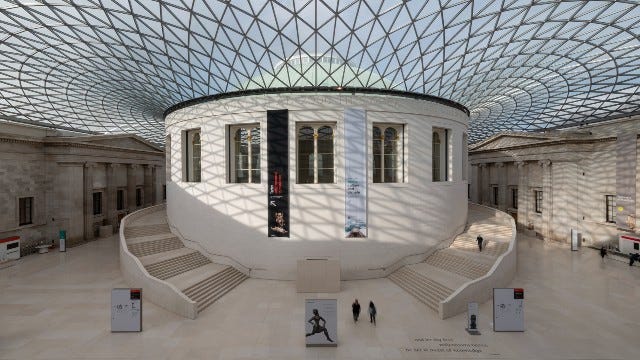
The effect of this architectural program is immediate and involuntary. When one enters an art museum, they automatically lower their voice, look reverently and carefully at what they see, even if they don’t understand it. The world outside: the traffic, the weather, the concerns of daily life, feels completely separate, almost trivial. Thick walls muffle the sounds of the city. Controlled light replaces natural time, making afternoon indistinguishable from morning.
In On the New, Boris Groys argues that museums function as spaces exempt from temporal flow. Once an object enters the museum, it is removed from the world of use, circulation, and change, placed in a realm where time operates differently, or doesn’t operate at all. What would decay in ordinary time (canvas, pigment, wood) is arrested mid-deterioration, and kept perpetually in what Groys calls a state of “permanent present”. Adorno saw this more darkly: museums as “mausoleums of culture”, spaces that preserve only by killing first. The painting must leave the artist’s studio. The sculpture must be severed from the temple it was carved for. Preservation requires death: the end of one life so another, static and eternal, can begin.
I’ve walked through museums in many cities, but unlike any other landmark, they barely register as part of those cities at all. When I think of the Getty Museum or the Tate Modern or even the Metropolitan, I don’t think of Los Angeles or London or New York. I think of every museum I’ve ever been to, all at once. They collapse into one another: white walls bleeding into white walls, galleries opening onto galleries, in an architecture that belongs to no city, no place, no time.
Last winter, I flew to Seattle on what would be my final trip with Caravan, the travel magazine I’d written for throughout college. It was Valentine’s Day. I was four days out of a relationship and four months from graduation. The fog was so thick that when we descended, the city could only reveal itself in fragments: cranes, ferries, rooftops. Everything was horribly gloomy. I was sad and scared.
It’s tradition for the graduating seniors to write two pieces: one about their travels, and one about their Caravan experience. When I first joined the club as a sophomore, inspired by the beautiful essays written by seniors before me, I fantasized about what I’d write for my final piece. Something devastatingly insightful. Something hopelessly poetic. The kind of essay that would make people cry and laugh and remember me for years after I’d gone.
But after nearly 3 years, 4 trips, and countless Taco Tuesdays (after being Editor-in-Chief, for fuck’s sake), I suddenly couldn’t find the inspiration. For the Seattle issue, I cycled through uninspired ideas: a profile of a local musician, something about the tech industry’s grip on the city, maybe a piece about coffee culture or the grunge legacy or rain as metaphor. But like the jobless English major I was about to become, I only concluded with intense angst and anxiety Everything was too sentimental or not sentimental enough, too personal or too distant. On my pitch form, submitted two weeks late, I wrote: “museums and time.”
It was with that razor-sharp artistic vision that I entered the Seattle Art Museum with a team of three photographers in tow. “Make it liminal,” I instructed them helpfully.
The museum was quieter than I expected for a weekend afternoon. The photographers dispersed immediately: one drawn to a stairwell where light fell in patterns, another crouching to capture the reflection of a sculpture in stone. I watched them disappear into different galleries, cameras raised, and then I was alone.
I started on the second floor, in a wing dedicated to modern art. The galleries were sparsely populated: an older couple studying a landscape, a woman sketching in a corner, a security guard who nodded as I passed. Through tall windows, I could see the rain beginning again, blurring the city into something impressionistic.
I wandered without much purpose, letting the rooms lead me where they wanted. Past abstract canvases. Past minimalist sculptures. Past photographs of places I’d never been. I moved through it all half-present, my mind on the pitch form I’d submitted, the vague promise of “museums and time” that I didn’t know how to fulfill.
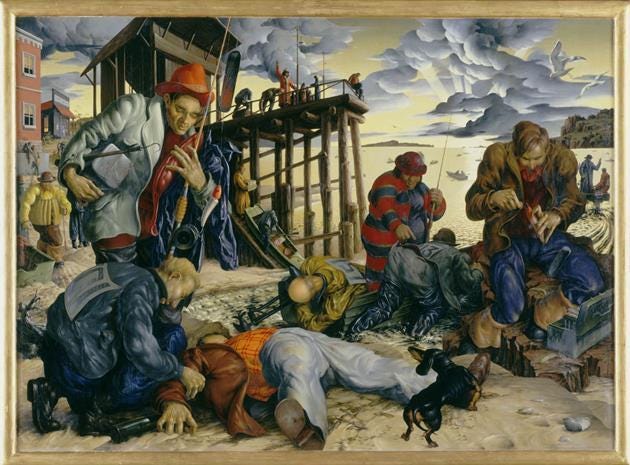
In one of the smaller galleries, I saw a painting titled Northwest Salmon Fishermen, 1941. It featured a group of men slumped against a fishing boat. As I read the placard, I learned that though it seemed like they were exhausted from labor, they were actually just very drunk—celebrating their win in the Seattle Times fishing derby, a contest with a huge jackpot. I chuckled. Took a picture. Thought briefly about how joy and exhaustion wear the same face once painted over, once removed from the moment that gave them meaning. Then, I moved on to the next room.
By the nineteenth century, museums had perfected the art of preservation-through-death. But by the twentieth century, some began to question whether this was sustainable, or even desirable.
In 1929, the Museum of Modern Art opened in New York with a striking proposition. Alfred Barr, its first director, wanted MOMA to be a “laboratory” rather than a tomb: an institution that could adapt to art as it evolved. The MOMA was stripped of classical ornament, its galleries arranged as white rectangles. Every wall inside could be moved and reassembled with each new exhibition. The space itself became temporary, mutable, responsive to curatorial vision.
Frank Lloyd Wright’s Guggenheim took this a step further. The building houses a single ramp that continuously spirals upward. Wright designed it to create a viewing experience defined by motion and changing perspective. As you ascend, artworks you’ve already passed remain visible below you across the atrium, still present but occupying a different relationship.
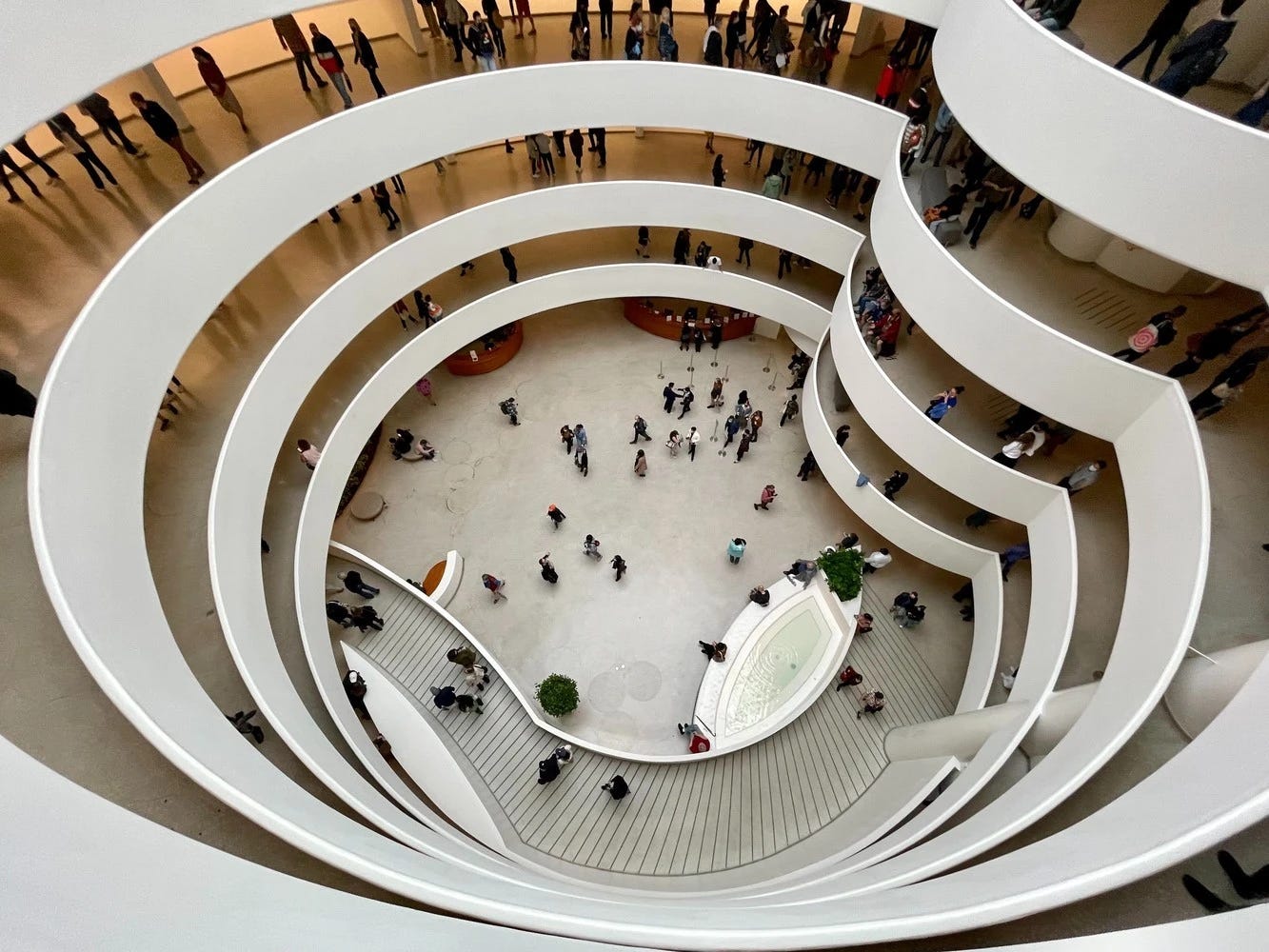
These modernist innovations seemed to promise a way out of Adorno’s mausoleum. If impermanence could be built into museum architecture, then perhaps preservation didn’t have to mean death. Perhaps museums could acknowledge that meaning changes, that context shifts. MOMA’s moveable walls admitted this explicitly, by allowing the same paintings to hold new meanings through changing placements. Similarly, the Guggenheim’s spiral suggests that even within a single visit, your relationship to an artwork transforms as you move. What you see from the bottom of the ramp isn’t what you see from the top, and neither perspective is the “correct” one.
But in his essay “Inside the White Cube”, Brian O’Doherty questions whether these innovations had truly escaped the fundamental problem. O’Doherty argues that the white gallery (MOMA’s signature aesthetic) had created its own form of temporal suspension, just as absolute as any neoclassical temple’s. O’Doherty writes that the white walls and controlled lighting aren’t neutral choices. Rather, they create an “eternity of display,” a space that claims to be timeless, universal, objective. But this timelessness was itself an ideology. By removing all traces of the outside world, the white cube pretends that art could be encountered purely, aesthetically, without the contamination of politics, economics, and daily life.
The Seattle Art museum was nearly empty now, most visitors having left for lunch or driven away by the weather. I passed through a room of abstract expressionism, another of Pacific Northwest landscapes, another I can’t quite remember. The rain outside grew heavier. I could hear it, a harsh percussion against the windows.
Then—the light shifted. The sound changed. Something in the air felt wrong, misaligned with the grey Seattle afternoon. I blinked but couldn’t place myself. I was standing in front of a painting, though I couldn’t tell you which one. Only that when I turned my head, someone was standing beside me.
We were facing the canvas together, close enough that I could see his reflection across the glass. The particular way the gallery light caught his profile, tinting it with silver. In the reflection, he turned toward me and smiled. My reflection smiled back in return. I felt a pang in my chest. I suddenly knew who he was, which museum this had been. The memory was so vivid it felt like living it again, like I could reach out and touch his shoulder, say something I’d never said.
And then it was gone.
—
What would I remember when I remembered this moment? What losses would define this ghost of me, the one standing here in the rain, four days out of a relationship, four months from an ending I couldn’t clearly see yet? Would it be the death of Berkeley, of Caravan, of late nights that stretched into early mornings, of a world that felt infinite but was now contracting into something I could hold in my hands yet not keep?
I wondered where I would be when I looked back. What city. What museum. What version of myself doing the remembering. Would I mourn this version of me the same way that I was mourning him, mourning her, mourning all the selves I’d ever left behind in all the museums I’d ever walked through?
Would I have kept writing? Would I still care about beauty, about sentences that land just right, about standing in museums trying to feel something true? Or would I have traded all of it for stability, for a life that made sense on paper, for the kind of happiness that doesn’t require constant fear? Would I still know my friends’ voices? Would I even recognize me?
I couldn’t tell where I was anymore. I was seven and twenty-two simultaneously. I was losing my mother and remembering losing my mother. I was standing beside the boy and mourning him. The floor beneath me felt like marble, then polished wood, then marble again. Somewhere behind me, I could hear footsteps that might have been a security guard or might have been my father, searching. A child counting under her breath. One, two, three, four, the sound round and certain as prayer. The photographers calling my name, or maybe that was already years ago, someone else calling a different version of me.
“Emily, look at this one.”
I blinked. The Metropolitan dissolved. The marble became polished wood again. Theo was standing beside me, camera in hand, scrolling through the shots he’d just taken. Kyle appeared on my other side. The museum snapped back into focus: Seattle, 2025, a grey afternoon in February. Just a museum. Just my friends. Just now.
Theo showed me his screen. “There’s a room on the third floor filled with teapots,” he explains to me, excitedly. Kyle interrupts to suggest that we get Moscow Mules after this. His tone was easy, casual, like we had all the time in the world.
I looked at both of them for a beat longer than normal. I remembered how we’d met when we were barely twenty: strangers at a Caravan meeting, awkward and trying too hard. And now here we were, twenty-two and graduating, standing in a museum in Seattle in the rain. Somehow in those two years we’d become people who traveled together, who knew each other’s coffee orders, who could spend hours in comfortable silence or talk until 3 AM about nothing.
I knew what would happen next. We’d get those Moscow Mules. Then we’d return to the Airbnb, pass out from exhaustion, wake up the next morning with our flight home, and pretend we had more time than we did. I would go back to Berkeley, back to my apartment, back to the last few months before everything ended. I would be sad and afraid, but I would show up anyway. Every Taco Tuesday. Every late night. Every moment I could steal with the people I loved most. I would try so hard to stretch time, to make it slow down, to memorize every detail before it all slipped away.
Then I would graduate. Pack up my life. Say goodbye to the coffee shop where I’d spent hundreds of hours pretending to work. Leave Berkeley and move to some new city I couldn’t yet imagine. These people would scatter into their own futures, and one day I would stand in another gallery, and think of them and this moment. I would wonder where they all were, how they were doing, if they are happy with their lives.
Perhaps this is what the museum has always understood. It doesn’t promise to stop time or bring back what’s lost. Only offers a space where the past comes up for breath to the surface. Where what’s already gone can linger for a moment, let itself be seen, before receding again.
Outside, the rain kept falling, blurring the city into soft grey. Theo was still scrolling through his photos, pausing on one of an empty stairwell. Kyle was checking his phone for nearby bars. I stood there watching them, still sad and scared, but now also oddly hopeful.
It will be enough. The blurry, bittersweet memory of it. The knowledge that all of this mattered. The knowledge that one day, I will remember it all.
Yes, one day I will remember it all. The rain, the fisherman, the teapot room.
My friends, how much I loved them, how much I love them still.
The late nights designing covers. The arguments over whose turn it was on aux. Cold coffee on long drives. My first trip, terrified of spending three days with strangers, before realizing I’d found some of my favorite people.
This moment right here: Seattle, 2025, twenty-two. Moscow mules, forced liminality, a lonely Valentine’s day
How I was: sad and afraid, knowing that it would all end, yet choosing to love it anyway.