

When I tell people I write poetry, the first thing they ask is: “what do you write about?”
Despite getting asked this hundreds of times, I still fumble for an answer. I know I could tell them I’m interested in “experimental forms” or “playing with rhythm and musicality”. These are true things that sound knowledgeable enough to satisfy the question, to give me credibility as a Serious Poet. I could name the writers whose words I write after: Terrance Hayes, Rainer Rilke, Louise Glück, Ocean Vuong. Maybe we’d find some common ground, have a real conversation about poetry.
But usually, I’ll still respond with what feels most genuine: I write about me.
I can sense the disappointment in this response. The unimpressed nod. The monotone “oh, cool.” Once, when I gave this answer, the person asked, genuinely confused: “So… like journaling?”
I understand the implicit criticism: that real poetry, real writing, should concern itself with something larger, more universal. That writing about yourself is navel-gazing at best, solipsistic at worst. That if you’re going to dare call yourself a poet, you must write about something other than yourself.
This expectation is not surprising. As an English major, I spent four years learning to value poetry as something completely separate from the poet. In fact, the first thing you’re taught in close reading, in criticism, in literary theory, is to avoid the biographical fallacy, or the error of conflating the author with their work. A piece should be evaluated through its formal properties, its historical context, or even through tangentially related texts or theories; but never through the author’s background, never through their intentions or circumstances.
As a reader and critic, this makes complete sense. When you encounter a finished piece, you only have access to what it achieves on the page through language and form. Biographical information, even when available, becomes a distraction at best, a misreading at worst. Relying on it reduces what writing actually does: transform lived moments into something that transcends their original context, speak to readers who know nothing of the writer’s life.
But as a writer, I stand with a poetic practice rooted wholly in myself, in my own life, my own observations, my own experience of being here. True, it would be more satisfying, certainly easier, to discuss my interest in rhythm and musicality, or to cite the works of theory and literature that inspire me. But, I’m not willing to prioritize product over practice, the finished poems over the work that came before them.
A few years ago, I found myself deeply in the trenches, and to emerge victoriously from them, I decided to cut class one Friday and go to the art museum. I spent an afternoon drifting through the de Young, listening to Beach House and cultivating my angst. Lee Mingwei’s Rituals of Care was showing, and I happened into the gallery during his Sonic Blossoms performance—an opera singer selects a guest at random, and serenades them. The experience was beautiful, confusing, and somewhat healing, but I left the museum feeling largely unchanged.
For reasons I still can’t entirely articulate, I decided to loiter by the fountain outside the museum. It was raining lightly. I felt tired of my own misery, and the whole scene felt uninspired, even irritating.
Then, I noticed him: a scraggly white guy wearing those trendy Carhartt pants, except his were soaked because he was squatting in the middle of the fountain, and methodically picking out pennies. His focus was absolute, reverent almost. He’d pluck a penny from the water, examine it closely, then drop it into a plastic jar with a soft plink. The rain kept falling, but he didn’t seem to notice or care.
Behind him, a cluster of young boys were terrorizing two ducks. They’d found a bag of stale bread somewhere and were hurling oversized chunks at the ducks’ heads, laughing every time they scored a hit. The ducks kept trying to swim away, but the boys would chase them around the fountain’s edge, relentless. One duck let out an indignant quack. The boys howled with delight.
The penny guy stayed focused on his work, unbothered by the chaos, and watching this absurd tableau unfold, I suddenly felt as if I was floating above myself. From this distance, I could see the museum steps behind us, tourists streaming in and out with their tote bags and confused expressions. The trees lining the plaza, their branches bare and heavy with rain. Cars passing, headlights reflecting off wet asphalt. Someone walking a very small dog. A food truck parked across the way, its menu flapping in the wind. The whole of a Friday afternoon happening around this fountain, everyone moving through their own lives, unbothered by the boys or the ducks or the penny man or me.
On the last day of high school, my English teacher showed the class David Foster Wallace’s Kenyon commencement speech, This is Water. He explained that this speech contained the most important lesson for a young adult; more important than anything in our curriculum, more important than our GPAs or college acceptances. My teacher was (and is) one of my greatest role models (hi Mr. Woods), so I tried very hard to find the same gravity in DFW’s words that he did.
While I didn’t understand it at the time, years later, towards the end of college, it finally clicked. Mr. Woods was right. This is Water turned out to contain not just my philosophy for being an artist and writer, but for living a creative and fulfilling life. If you haven’t already listened to it, I can’t recommend it enough.
🐟 🐟
Two young fish are swimming along when an older fish passes by and asks, “How’s the water?” The young fish swim on for a bit, then one turns to the other and asks, “What the hell is water?”
The point: the most obvious, important realities are often the hardest to see.
For most of us, Wallace argues, the water we swim in is our default mode of consciousness: self-centered, automatic, barely aware of our own awareness. He gives the example of standing in a supermarket checkout line after an exhausting day. Everyone is moving slowly. The person in front of you has way too many items. The cashier seems brain-dead, making several mistakes. The whole scene feels designed to waste your time, and obstruct your very reasonable need to get home.
When we view the world from this default setting, we filter everything through our own judgements, anxieties, and annoyances. We don’t actually see what’s in front of us, only how it relates to our experience of it. For example, we don’t pause to consider that the cashier has probably been on their feet for far too many hours, that the person ahead of us might be shopping for a sick parent or child, that everyone in this store is probably also exhausted and trying to get home.
Obviously, there’s no subtle way to know if these things are true. But at the very least, we can recognize that they might not be false. And once we’ve opened ourselves to those possibilities, once we’ve chosen to direct our attention outward rather than inward, we might also begin to notice other things: the fun, fluorescent quality of the supermarket lights. The particular cheesiness of the muzak playing overhead. The ridiculous and absurd candies lining the checkout aisles. Then, this weekday, mass-consumerist, overcrowded hell-scape might reveal itself to be something else entirely. Perhaps not pleasant, but bearable and maybe even interesting.
This is what DFW argues: that you have a choice in how you construct meaning from experience. That your default setting isn’t inevitable. That all the tedious, frustrating, unsexy moments don’t have to be tedious, frustrating, and unsexy if you’re willing to do the work—and it is work—of attending to them differently.
I’ll admit that this is a thankless and tiresome task; one that requires constant intention, empathy, and discipline. In pretty much every situation, it is the harder, less natural, and more exhausting thing to do. DFW admits this himself, stating: “it is unimaginably hard to do this, to stay conscious and alive, day in and day out.”
But here’s what I also believe, what has become increasingly clear to me the longer I try to do this work: the practice of attention, of choosing to stay awake to your own life, over and over, even when it produces nothing—this is the actual work of being an writer.
To be clear: this isn’t an argument against Writing with a capital W, and it’s certainly not a case for navel-gazing while the world burns. Today, right now, this moment we’re living through, we need writers engaging with the pressing, the political, and the radical. We need that more than ever.
But you can’t engage meaningfully with these issues purely from the ideological or theoretical. You can’t write honestly about empire if you’ve never bothered to notice the person standing next to you in line. You can’t write about human suffering if you’ve spent your whole life on autopilot, sleepwalking past the actual humans around you. The practice of sustained attention, of meeting the world with curiosity instead of contempt, doesn’t start with grand abstractions or history-making.
At the fountain that day, the longer I watched, the more something shifted. My annoyance gave way to urgent, almost embarrassing curiosity. Why did this man need pennies so desperately? Where were these boys’ parents? Should I gather these ducks into my arms and protect them? It felt like the world had cracked open for me. I started to notice the expanding circles that the rain made on the fountain’s surface. The plink of pennies hitting the jar. The shade of gray that the sky had turned, both so heavy and so soft.
This is Water.
I was just about to step in for the ducks when, suddenly, like some karmic retribution, the fountain’s sprinkler turned on. The boys were drenched, the bread dropping from their hands in a soggy defeat. The penny guy was drenched too. He stood there, still, holding his jar and watching as the boys groaned and backed away reluctantly. When the ducks—liberated and victorious—started pecking at the discarded loaves, he began to laugh. It was a genuine, surprised laugh, one that seemed to cut through the rain. I started to laugh too, and the guy raised his jar of pennies towards me: a toast, scented soggy and sweet.
This is Water.
When I got home, I immediately wrote a short description of the scene, titling it “0101” because it felt like one of the first moments of my life.
Over the next few weeks, I began to take notice of the other mundane and pleasant sights around me. Late-night ramen with my friends, the way steam rose and fogged the windows. The flick of my cat’s tail when he’s in an irksome mood. A stranger’s laugh on the BART. Gradually, these observations expanded into a long-form poem, titled “Reasons to Love.”
This is Water.
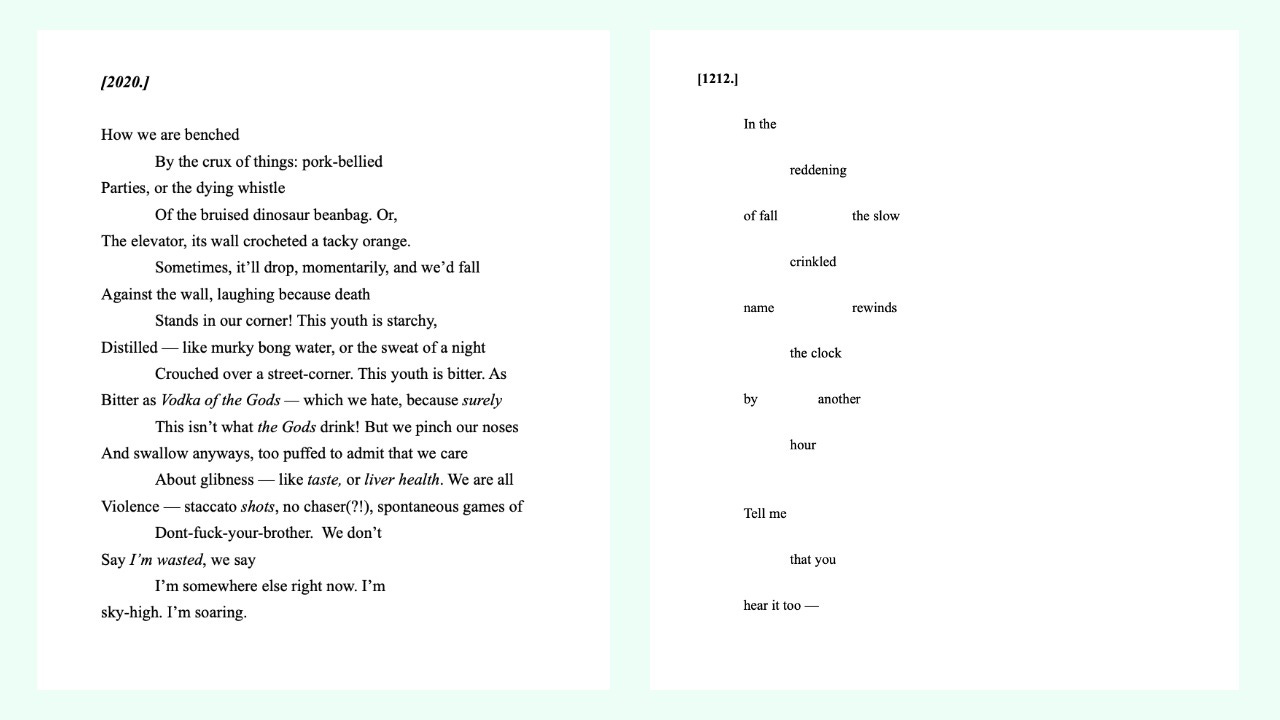
I won’t claim to have mastered this art of being awake and aware. In fact, I’m not even close to it. I get annoyed by petty, insignificant things all the time. I feel strong tinges of resentment towards strangers who knock into me at the club, or cut the bathroom line. I’m often bored and inattentive towards the mundane, rushing down streets and arriving home with no memory of what I rushed past.
I also won’t claim that “awakeness” always produces great work, or even any work at all. In the rare moments when I do manage to notice something—a stranger’s shoulders drooping as they sit down on the BART, the rhythm of my roommate’s footsteps when she’s had a bad day, construction workers arranging their lunch on scaffolding like it’s a dining table—these observations rarely become poems. Most of the time, I forget about them. Or I remember them weeks later and can’t recall what made them feel urgent. Or I write a single line in my notes app that reads incomprehensibly: “blue jacket Tuesday??? Important.”
This might present a troubling implication. If the work of being a writer is an excruciating and constant attention to ordinary life, but most of that attention never materializes into finished work, then why bother? Why not pursue the grand themes, the theoretical frameworks, the subjects that justify themselves through their own importance? Why indulge in our silly little lives? Why write at all?
Many days, I ask myself these exact questions. But here’s what I’ve slowly come to understand: to the writer, the value of writing is not in what gets written. Rather, writing is a way of living intentionally. It’s choosing to believe that ordinary moments contain something worth our attention, not because they’ll become Art, but because this is it. This is the life we get. This boring, frustrating, and unsexy life that we spend so much time trying to transcend, but that actually contains all the meaning and beauty that there is in the world.
It’s hard work. Unimaginably hard work, even. But the discipline of noticing shapes not just what we write but who we are. Someone who was here. Someone who took seriously the task of being alive, who chose to meet the mundane and often dispiriting experience of being human, joyously and carefully.
Isn’t that enough? I think it’s enough. To notice the flicker of your cat’s tail, the deflating dinosaur beanbag, the harsh cafe light of morning. To forget most of it by nightfall and notice again anyway. To notice again. To write poems that don’t capture a moment and keep writing anyways. Isn’t that cool? Isn’t it cool to live attentively? To notice? To indulge in yourself?
A few nights ago, I was walking home when it started to rain. I didn’t have an umbrella, so my first instinct was to run inside and get to comfort. But for some reason, I slowed down instead.
I noticed how the rain changed the smell of the pavement. How some people broke into a jog, while others didn’t seem to register it at all. One person stopped completely in the middle of the sidewalk and tilted their face towards the sky. Like they’d been waiting for this. Then, they closed their eyes against the downpour and smiled.
I smiled too, feeling like me and this stranger had some implicit understanding. Like we both came to the same conclusion at the same time: This is Water. This is Water. This is Water.
Isn’t that beautiful? That we get to choose. That the choice matters even when it produces nothing. That this choice, this is something you can carry with you even when the poems fail, even when you can’t write at all. It lasts. I think it lasts. It must last.