

“I demand the right to opacity, which is not confinement” – Edouard Glissant
I’ll start by telling you something that I’ve never told anyone before.
Suppose that I am looking down at my hands in shame as I say this. Fiddling with my fingers as I preface things to you in nervous and rambling beats. I’m not a particularly religious person, I begin. I’ve never taken bread as meat or danced with pale, lingering spirits. I’ll only buy a crystal if I like the shape and color of it. But — my voice drops — I’ve always felt that I lived a past life at the bottom of the ocean. Without even believing in past lives, I can close my eyes and imagine it.
Here is a second confession, offered in the same breath: perhaps that is why I am so scared of it. Suppose that only the enormity of my fear of the ocean rivals the enormity of the ocean itself. That, at the beach, I refuse to wade beyond knee-deep waters, eyeing the waves instead, like some jilted lover. Suppose that the waves are eyeing me back. I hate the crust of salt on skin, I say. I hate the oily arrogance of the beach and its whimsical crustaceans. Kelp against skin is the worst kind of touch. Don’t even get me started on disproportionately sized fish. Why are tuna so big, anyways? Isn’t that scary and suspicious?
Since we’re already confessing, I’ll give you a third thing now. I am saying this to you through a black veil, the kind that they use in those religious confession booths. So I guess you could suppose we’re in a church, or something. Suppose that my voice is trembling. That I’m shredding a napkin in my lap without noticing that I’m doing it. I clear my throat.
You’ve wasted your love on me, I say. I’m a dead poet living every writer’s dream. As loveless disciples starve in the city of language, I tell you everything but the truth. That I dream only brown-noised dreams of hell. That the poet in me has been dying since we fell in love.
*
Before I started writing this essay, I tried to write a poem for you.
It was going to be called “I Wanted To Swim With Sharks With You”. A love poem, even though I’ve sworn off love poems.
As the title suggests: in it, you would’ve been my imaginary lover and I would’ve led you to shark infested waters. As the title suggests: our romance is doomed.
In a hierarchy of height, we’d be the bottom dwellers. Prey to everyone, and prey to no one, perhaps deadlier than each other.
In the poem, I would’ve described this as kissing with teeth. In the poem, I would’ve described this as stained white linen. Cryptically stained white linen, like the white linen of an abandoned white and (now) red bikini. Or an inked tattered sail, freshly swept back to shore.
Radiohead’s Weird Fishes / Arpeggi would be playing from the radio as I circle you. On our necks, claiming marks, yours
never breaking the skin that it chastens.
*
The summer before my senior year, I decided to shoot my shot at Iowa’s legendary MFA program. I spent weeks in Doe library in preparation for it, picking apart my portfolio and actively ignoring my honors thesis. Armed with nothing but a banana latte and a dream, I sat there, religiously and for hours. Often, I was in an otherworldly stupor. Whole afternoons passed as I stared down the rift of a misbehaving stanza or a bad metaphor. Every poem that I’d ever written was cruelly dissected; hundreds of them. Each rhythm, I played over and over. Each line, once broken, I broke again.
As I worked, I’d obsessively listen to Iowa’s poetry admission video on YouTube. Specifically, I’d rewatch the part where the admissions committee breaks down what they’re looking for. “We are looking for the individual’s need to turn to poetry”, Mark Levine says, his eyes level with the lens. Elizabeth Willis leans in, asking the question underneath his: “Yes, what is the thing that can only be said in a poem?”
What is the thing that can only be said in a poem? That summer, these words were like a compass to me. Most days, I could not have told you how I ended up in the Roger W. Heyns reading room of Doe library, only that these two strangers on a screen had somehow led me there. Without them, I would not have known where else to be.
What is the thing that can only be said in a poem? I remember how, before we fell in love, these words rang so deeply to me. Sang to me, even. The first time I heard them, months before I had even decided to apply, I thought they were the most beautiful words that I had ever heard. Sitting on the fifth floor of Moffitt, I let the whole room watch as fat, messy droplets fell down my face. I was not embarrassed to cry so publicly. I did not care. Though I could not name it, this “thing,” I knew that I had it stored somewhere. I felt that all the rejection in the world could not take it from me.
But as I worked on my MFA application, I repeated Elizabeth Willis’s question under my breath, over and over. Until it lost shape. Until it began to sound like a prayer. What is the thing that can only be said in a poem? What is the thing that can only be said
in a poem? What is the thing
that can only be said in a
poem?
*
For my 7th birthday, my father, in typical Asian father fashion, gifted me a book of 100 Shocking Facts. “Learning is the greatest gift of all” he crooned as I tore open the wrapping paper. Though we both knew that I had asked for a Barbie Dream House, the book had good pictures, so I spent hours flipping through it anyway. My father would sit beside me as I read, collecting my newfound knowledge like medals.
I learned that cheetahs run 120km/h, three times faster than the fastest man. Look at that coat, my father said when I told him. I learned that the deadliest tornado killed more than 1300 people. This is why we practice the drills, my father replied. I learned about the first airplane, the seven ancient wonders, and all of the tallest buildings in the world. Proof, my father said, of what people can do when they try. My favorite facts were the ones about the ocean. That year, more than seventy percent of it was still unexplored: a fact I could not believe.
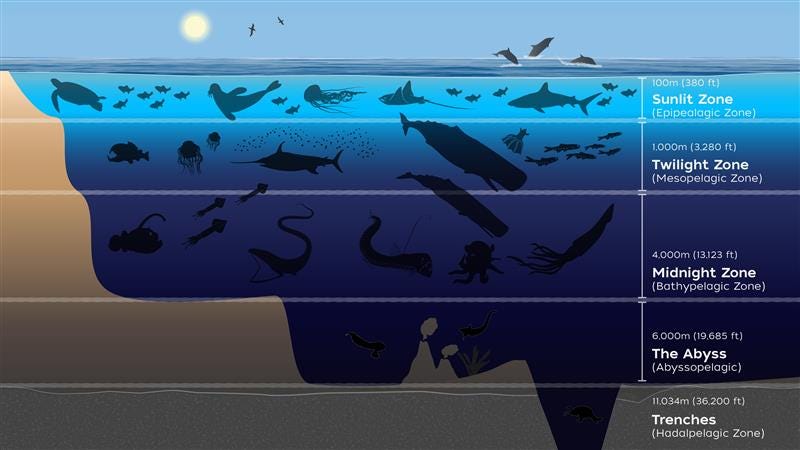
On the next page was an illustration that showed the oceanic zones, and once I noticed it, I lost interest in the rest of the book entirely. To my father’s slight displeasure, I spent hours analyzing that drawing, memorizing how the depths were marked off and what lived at each one. Tracing the dipping ocean floor, I’d let my fingers swim from Sunlight to Twilight to Midnight—
I always stopped short of the lowest band: “the Abyss”. The waters of the Abyss were illustrated entirely in black, and the little inhabitants that it had were rendered with the faintest outline. The book explained that this is partially because the Abyss’ conditions make life nearly impossible, and partially because no one actually knew what inhabited it. I didn’t even want to touch it on paper.
But I was a morbidly curious kid, so late at night, long after my parents had fallen asleep, I’d sit at the family computer and dare myself to watch deep-sea footage on BBC. I’d play it in the dark for as long as I could stand it, studying the screen through my fingertips.
I learned that most deep-sea creatures have never been observed alive. They are known by their dead bodies, or not at all. For example: while we’ve written about the giant squid since the time of mythologies, for over a hundred years all we actually had of it was a single beak, pulled from the stomach of a whale. It was in 2006, 153 years after it was first named, that anyone filmed one alive. If something that large could hide from us for centuries, some BBC ghoul intones, what else might be down there? Best case, I thought shuddering: mermaids. Worst case: aquatic Slenderman.
Despite my terror, come morning, I’d find that I missed it. The dark waters, thick with marine snow, and gradually more familiar to me than the jungle-printed walls of my bedroom. Worse, I began to recognize them. Those unnamed creatures, as elusive as they were strange. Somehow, I could read their bodies more fluently than my own.
Convinced that this was a prophecy, I repeatedly asked my parents about the afterlife. Then, what the chances were of going blind and deaf in my sleep. What I should do if that happened. How I would know that I hadn’t just died. Very low, they said, unreassuringly. Nothing. You’ll know.
*
I’ll offer you another confession now.
Suppose that I am having trouble with beginning it. I’m stalling in typical English major fashion, and littering quotes around us like cinema candy: E.B. White once wrote that writing is an act of faith. (I’m a faithless creature, I say.) Ocean Vuong, in Ars Poetica as the Maker said “I would go // too far because I too, // needed a place // to hold me.” (I step to you slowly, looking at your arms in question.) Joseph Beuys, to begin his lectures on art: “and once again, I should like to start with the wound.” On my body, little bruises everywhere that your eyes touched. Finally, I look down at my hands.
I’ve been blind and deaf for years, I say. I woke up senseless from sleep, but I’ve been a strange and eyeless thing for so long that I did not know it. Just last week, I learned that when my dad was 23, he was a diehard Michael Jackson fan. President of the Chinese MJ fan club, he was the best moonwalker in town.
*
In another version of I Wanted to Swim With Sharks With You, you, my imaginary lover, would have craved gentle waters. Shallow waters. Not the river bleached // with rage, or the sunkissed close // of storm, but water that never asks // you to surrender to it.
As the title suggests: in it, I would’ve adored you. As the title suggests: in it, our romance is doomed.
In certain low and drunken hours, I would begin to feel a near-religious calling; I would begin to dream of swimming with sharks with you.
In the poem, this would be very romantic: two bright torsos in a dark abyss. Illegible to everything but each other.
Looking up to find that a sea of fish was even more indifferent than a sky of stars. In the poem, this would have been a metaphor for freedom. In the poem, this would have been a metaphor for love.
*
In Cabo two years ago, my friends and I went to Chileno Beach to snorkel.
I’d been determined to conquer my fear of fish for years, and right off the sand of Chileno, there were thousands of them. The water was so shallow that not even our thighs were submerged, but our ankles were surrounded by fish of silver and yellow. I gripped onto my best friend’s shoulders and yelped every time I felt something brush against me. I flinched like how I flinched that first time you saw me cry.
That night, I sat on the balcony and tried not to think about how I left that experience the same way that I entered it: a coward with the heart of a tourist and a stranger to the land of poetic bravery. I tried not to think about how, like a jilted lover, there was nothing of the day that I wanted to share with you.
So instead, I stared into space and listened to Ode to the Mets repeatedly. Then, I put on The Marías and thought about my ex, which I promised myself that I wouldn’t do. I thought about the poem that I had written for him at the beginning of our relationship. How it was the last poem that I’d written for the sake of it. I thought about how No One Noticed was one of many songs that reminded me of him, and how songs were the only thing that could because I no longer had the words myself.
This train of thought made me a bit uncomfortable, so instead I thought about how, earlier when I had finally worked up the courage to paddle past the shallows, I immediately choked on my snorkel and turned back. I remembered how the ocean floor had dropped away from me into a blue that I could not follow, and how from the balcony, I could now see the waters that I fled from.
In fact, I could see the whole geometry of our neighborhood laid out beneath me: the sharp modernism of our Airbnb giving way to a lux marble pool, the marble giving way to rickety wooden shacks, gray and crooked beside the construction sites that would someday, supposedly, hold more marble. Men building shacks from scrap wood and tin, in order to build mansions that they would never sleep in. I briefly thought about how there was probably something to be said, to be written, about those shacks. How, in a sad and unfair way, they were also leaps of faith. Sacrifices, even, to the religion of creation, those shittily-built shacks, erected from the ground just to be torn down once something greater stood in their place.
Perhaps, if I’d thought about it a little longer, I would’ve seen that this reminded me of my parents. Of writing. Of falling in love. Things that I fear, owe everything to, and would be nothing without—all held up by the same warped plywood, the same rusted nails. Perhaps, then, I would’ve remembered how Roger Reeves wrote “I want to know how the savage wind loves the house it destroys”. Or how Franny Choi wrote: “we rang for words to ward // off sleep to warn to want ourselves”. Or how I once wrote, in that aforementioned poem: “because reason has called my name // but now, so have you”.
But instead, I thought about how I felt bloated and sad. How I did not want to write a poem about the fish. How I had not written a poem about fish in years. Just as I had not, I realized, ever written a poem about you.

*
Yesterday, I confessed to my therapist everything that I am confessing to you and she says: I want you to remember that you are a unique, kind, and considerate girl. I want you to internalize that you have nothing to fear. If life was a dog park, you’d be the friendliest golden retriever on the block!
What she does not say: that golden retrievers do not starve for their art. Like me, they are fed, on schedule, by the people who own them.
What she does not say: that perhaps the misconceptions I fear are nothing more than grains of truth that I cannot accept. That when I was fifteen and angry, I described myself with the metaphor of broken glass. That a bad, overt metaphor can still be true. That my metaphors are still bad. That I wrote so honestly, and believed it so completely. That I wrote honestly at all. That behind the veil of poetic image, you would see me for what I am. That in the ocean of language, I am the smallest of fish. That fish are one more thing that I am afraid of.
*
Wound, do you remember me?
Do you remember how I made you glow?
*
When I was seven, I announced that I wanted to become a lawyer and it became a family heirloom. My parents praised my “decision” so much that the title of a lawyer became synonymous, in our house, with superhero. A superhero that was really good at arguing with people—which I was. As I got older, I learned about partner tracks and billable hours. I learned that lawyers aren’t typically known as people who dedicated their lives to helping others. What’s that joke about the lawyer and the mosquito? One is a blood-sucking parasite. The other is an insect. Still, at every Chinese New Year dinner, my grandmother would speak so excitedly about my future that I knew I couldn’t give it up. “You’ll be so rich that you’ll take me on my first sports car ride!” she’d say.
So I studied for the LSAT between poetry seminars. I joined the Mock Trial, and won national awards for poetry. I made lists of all the famous law professors at Berkeley, but became close with all of the writers instead. While drafting my law school personal statement—an essay about poetry, I blasted Jannabi’s Dreams, Books, Power and Walls—a song about the impossible dream of art.
Whenever I told people that I was pre-law, I’d always preface it with: but eventually, I want to be a poet and a professor. “Wow, that’s so cool,” they would say. “Once you make money from law, you can do whatever you want… even poetry.” I clenched my fists. Tried to believe that this was true, that I loved copyright law, the branch that I had selected for its proximity to the arts.
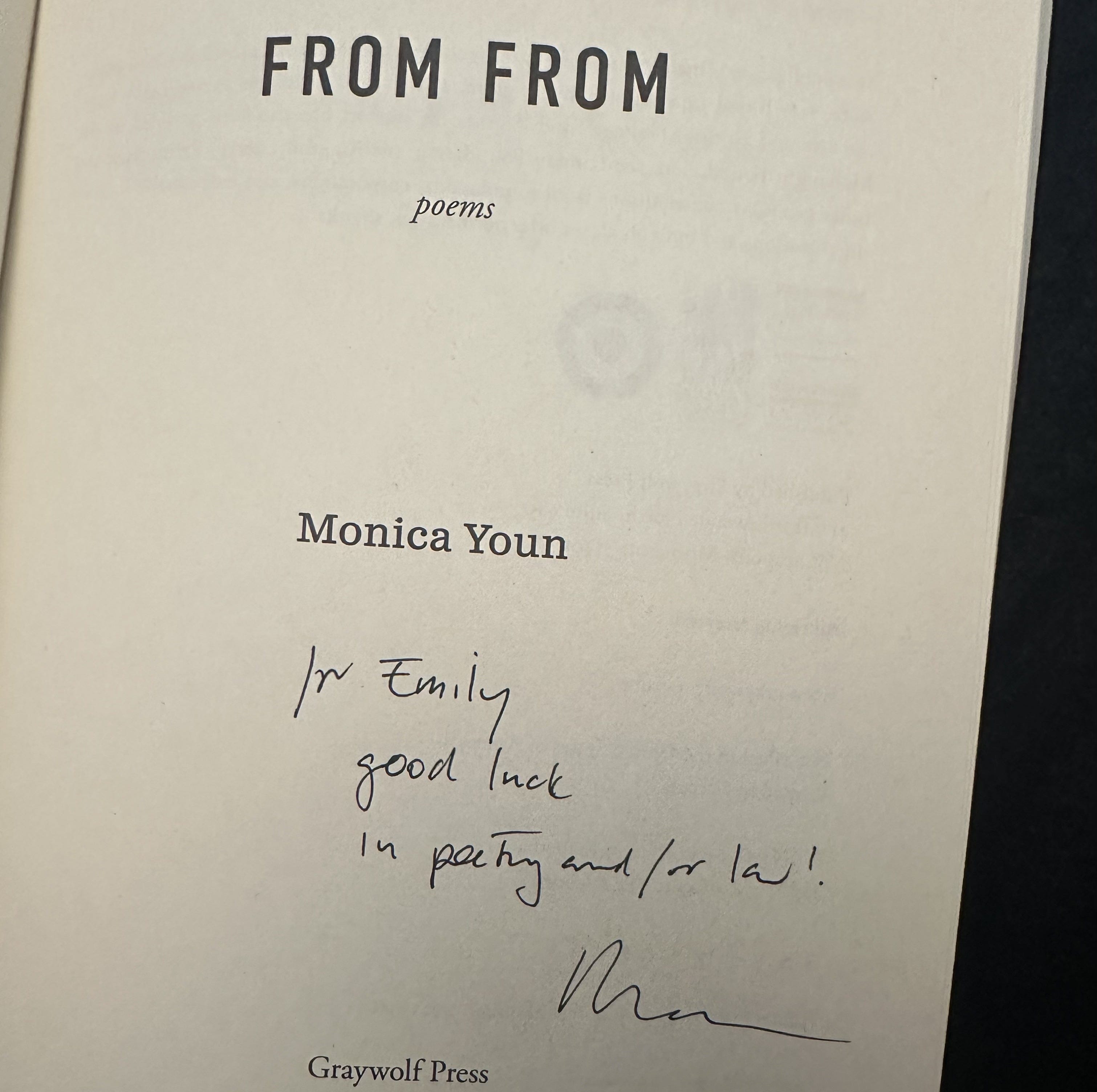
At night, I’d read articles about Monica Youn, a Yale Law–trained attorney who later became a poet. Reading and rereading her collection Blackacre, I tried to convince myself that I could do it too. That the language of law would not deaden me.
To foster the raw scion as if it were a son; to siphon light down through its body as if it were your own, Youn writes. I highlighted it. Dreamed of a day 20 years down the line, when I could write too.
*
In another conversation with my therapist, I list the other things that I haven’t written about in years:
The glass railing of my childhood balcony. Remember it?
Silverfish against speckled walls // Palms, scattering them like snow.
Three strange blind fish, my vices.
A cul de sac, but drunk!
Cool names. Jezebel. Midas. Ziggy, like Ziggy Stardust. Apple. Cloud?
Clouds that look like yachts. Yachts that look like clouds.
The walnut shell, splicing skin as you open it. A door, somewhere, opening too.
Underwater music, low and unopened.
All of my favorite songs: Last Night On Earth, Wish You Were Here, November Rain.
My cat, Chonkers, and I fall into a routine. It is dictated by his automatic feeder.
Tuna in the Monterey Bay Aquarium. Like, why are they sparkling?
Tuesdays in the city, Thursdays at home.
I wobble, but I love it.
Across a green pasture, a familiar voice calls my name.
Your apple sliced smile, my imaginary lover.
The white eyed wolves. The house and the crow inside of it.
*
Wound, have I confessed to you? Have I told you
that my father was the best moonwalker in town?
*
I will give you my penultimate confession now. Suppose that the veil between us has been lifted. Suppose that we are no longer in a confessional, but an office bathroom. I am telling you this while smoking a cigarette. The same cigarette that I once swore I’ve never smoked before.
A few years ago, I went to see Ocean Vuong speak at City Arts in San Francisco. Time is a Mother had just been published, and I was ready to feel inspired. The greater Bay Area seemed to have the same idea, because the auditorium was packed for it. I basked in the front row seat that I had lined up for and took notes religiously. Tears rolled down my face at every other sentence that Ocean said.
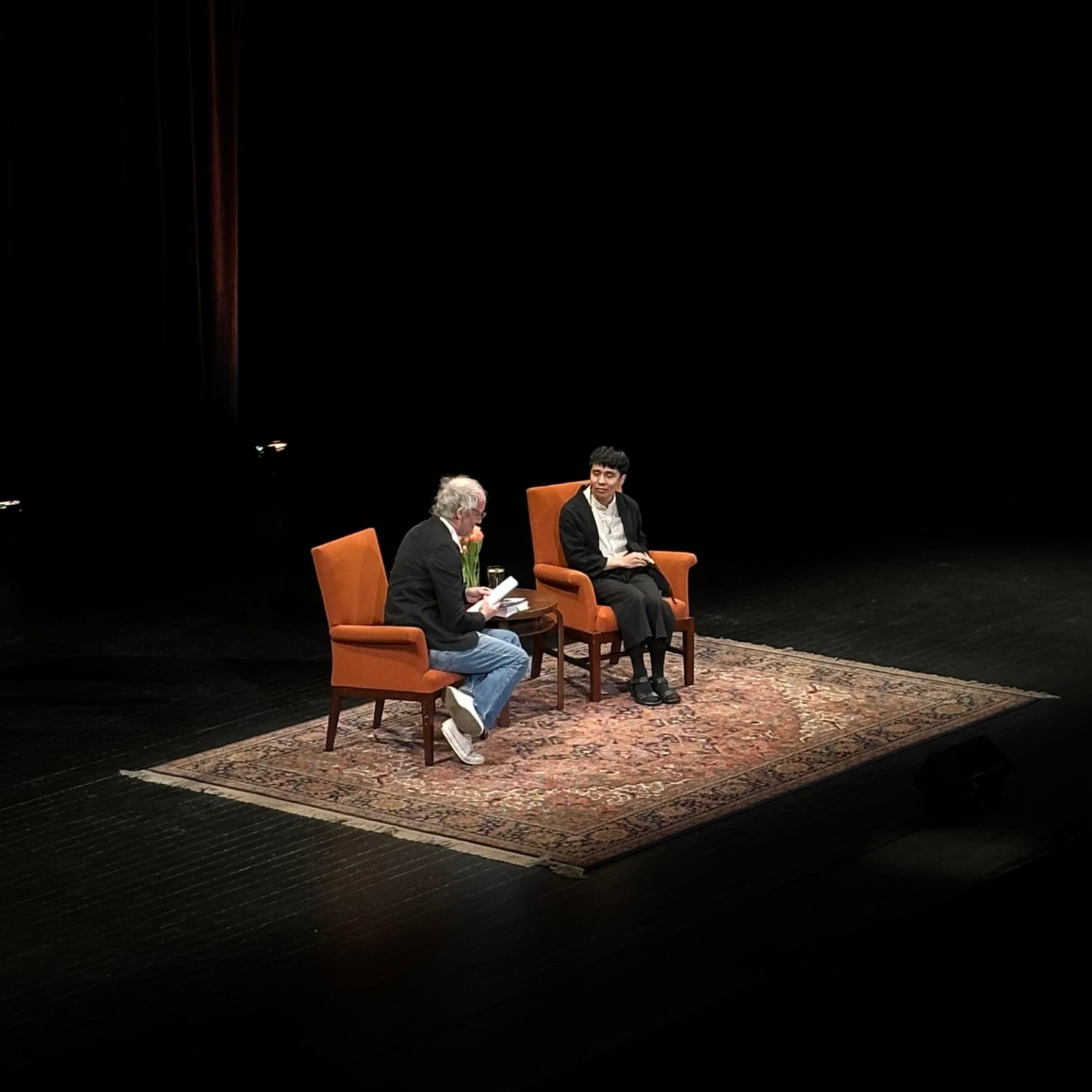
Half-way through the talk, he read the poem You Guys, a poem about writing and writing badly: “you guys are // you listening I’m sorry // for being useful only // in language”. Pausing for a moment after the reading, Vuong looked out at the crowd. I was so moved that I felt like he was looking directly at me. “The desire to be a writer is enough,” he finally said. Then quieter: “it is the only permission you’ll ever get”. I cried the way that I cried on the fifth floor of Moffitt. I was not embarrassed. I was not quiet.
I look at you now. The cigarette is still dangling from my lips. Suppose that I clear my throat and actually have the nerve to look ashamed. Finally I speak: perhaps all that I’m trying to say is that I remember. I remember that naive little thing, twitching to write about “cockroaches”, “broken glass”, edgy teenage metaphors at every turn, before we fell in love. Perhaps all that I’m trying to say is I’m sorry.
*
Suppose that I gifted words to you.
Suppose that I gifted words to you, and asked you to surrender to me.
To these fingertips of mine, fingertips that could always yield or be yielded to weird fish with teeth.
Would you stay?
Would you stay, if I asked you to?
Or would you dart away in fear?
Would you dart away in fear from the sharks, or from me?
I guess it doesn’t matter now.

Suppose that I have never written a poem about you
because I do not want to write myself standing in the November Rain,
at your door.
*
The semester that I was supposed to be finishing my law school applications, I was in a poetry seminar with Cathy Park Hong, instead. It was about poetic disobedience, and the goal of the class was to learn technique well enough to break it. Poetry, Cathy told us on the first day, is like a glow stick: you have to break it to create something that glows. For one assignment, I wrote a sonnet that was only questions. For another, an elegy that was a giant palindrome. Hours, I spent on that class, while my law applications sat unfinished in another tab. I told myself this was just the enthusiasm everyone has for their favorite elective. I did not let myself think too much.
Towards the end of the semester, I finally worked up the courage to ask Cathy for a letter of recommendation at office hours. She was eating lunch at her desk when I walked in, one of those sad, wilted Whole Foods salads with no meat. After 10 minutes of small talk, I finally cleared my throat and asked. “Cathy…I’m applying to law school in the fall to study copyright law. I want to focus on working with writers and artists, and was wondering if you’d write a letter of recommendation for me?”
She looked up sharply, and my heart leapt to my throat. Cathy stared at me for a long time, the way that she often looked at a poem when she was about to tell you that the line wasn’t earning its place yet.
“I’ll write it”, she finally said. Another silence. “But please… and I wouldn’t be saying this unless I truly believed it: you’re too talented not to pursue poetry. If I didn’t think that you could do it, I would just say that law is really good for you”.
I didn’t say anything back. I was quiet for a really long time. And then, humiliatingly, I began to cry.
*
What is the thing that can only be said in a poem?
Though I did not know the answer, as I sat there sniffling across from Cathy, I somehow understood that I’d die for it. Or perhaps more accurately: I’d live for it. I’d give it all up, I realized, for it.
Spend eternity indebted to my parents’ sacrifices, for it. Face my family across the holiday dinner table for it, their disappointment, round and heavy. Why not law? they’d asked, over and over. Then: how about business? Finally: at least fiction or journalism? Poetry is dead. Yes, I would endure a lifetime of these conversations for it. Become the artistic black sheep in a family of engineers and take it, and take it, and take it again, world without end, for it. I would do it even if it came to nothing, yes. For my words, I would give it all.
*
Wound, do you remember the plywood and the rusty nails?
Do you remember what came after?
*
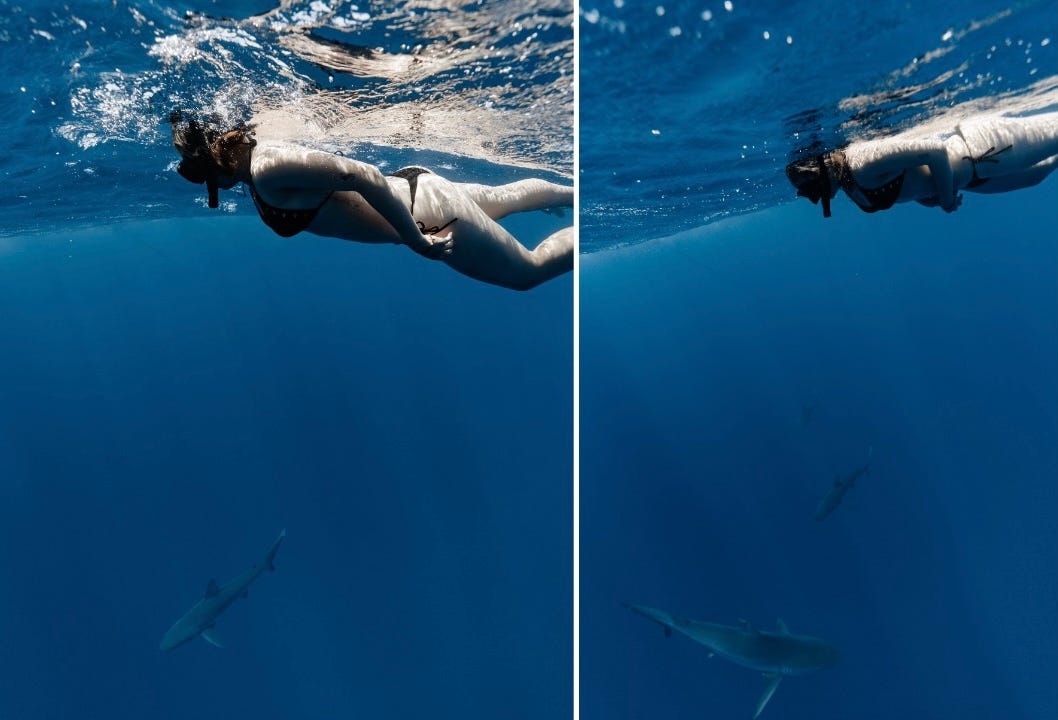
In order to write this essay, I flew to Hawaii to swim with sharks. Yes, actually.
I thought that this would be the crux of this piece; the epiphany.
I had, if I’m honest, more or less storyboarded it already.
But now, after all that we’ve been through, there is not much that I want to say.
Only that it was just how I imagined it in my poems: this cold, dark world, where I was the strangest and smallest of fish.
The gentle indifference of the ocean welcomed me like a warm embrace, and I embraced it back like an old friend.
Like my poems, it all felt very romantic. Like my poems, I could’ve been doomed.
Beneath me, the blue had no bottom.
Around me, sharks emerged from the darkness like silver arrows.
Like shittily built shacks, like falling in love, like writing, this too was a leap of faith. One that I was taking.
For some reason, I did not falter. For some reason, I was not scared.
*
In the final version of I Wanted To Swim With Sharks With You, you would be the discarded yellow towel and I would be the shark that mistook you
for a falling tropical fish.
Your dance to dark water would be the most beautiful thing that I’ve ever seen.
Me, a weird fish with sideways eyes and teeth, would be the most beautiful thing that you’ve ever seen too. The most deadly.
In my poem, I’d make some bold claim here about the nature of love and surrender. How a yellow towel brushing against a shark’s cheek is, perhaps, not so unlike a first night
between lovers. A hoarse breath threaded through ivory teeth, you immediately saw my most vulnerable part, and grazed it.
*
What is the thing that can only be said in a poem?
I had been answering that question for years without even knowing that it was a question. I am not good at expressing how I feel in conversation, but on the page, I am eloquent and honest. I am not afraid.
I am not a religious person, but in words, I am full of devotion. I write bread as meat, and past versions of myself as pale lingering spirits. On this page, my own little prayer for you. The church of words, a cult I’ve subscribed to. Words so precious, I’ve splayed them and laid them out at the altar. Words so precious, they’re all I have.
I am not a sentimental person, but every poem that I write is a love poem. Because learning is indeed the best gift of them all. Because, you will never surrender to me. You will never catch me alive. Because words in parentheses are still words on the page. Because I want you to misunderstand me. I want you to blow your nose with my poetry, and then toss my love aside. Because I wake up every morning, blind and deaf, knowing that I did not die in my sleep.
*
And now: my final confession. I suppose that it’s only fitting that I tell you something that I’ve never told anyone before.
I’ve always felt that I lived a past life at the bottom of the ocean. Without even believing in past lives, I can close my eyes and imagine it.
Love seeing people play with ergodic text
"My cat, Chonkers, and I fall into a routine. It is dictated by his automatic feeder." made me laugh hahaa